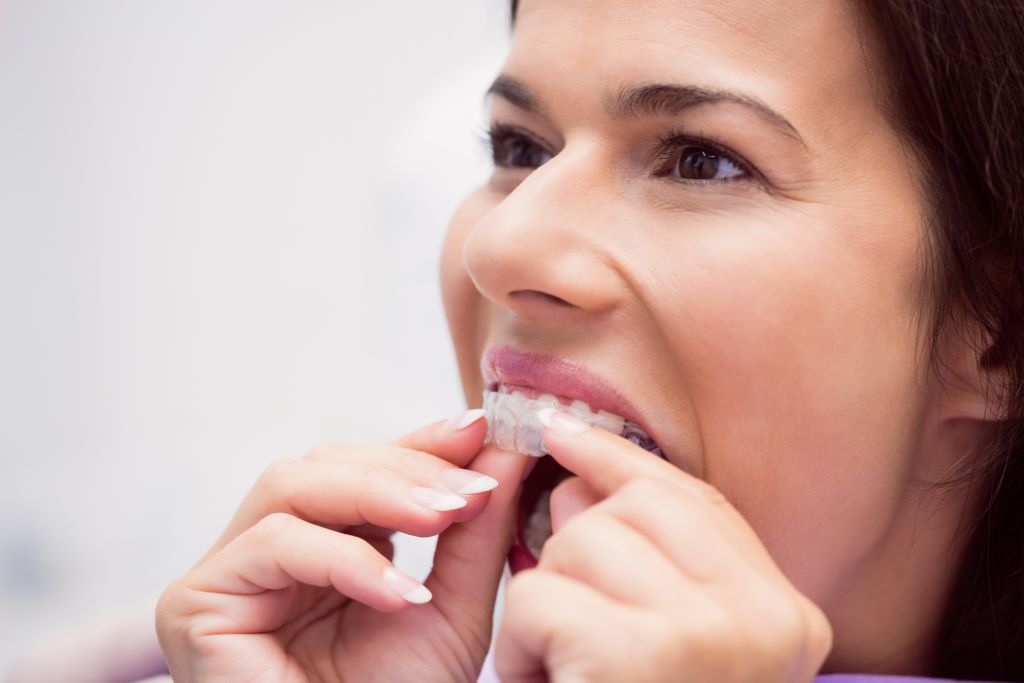
You might look in the mirror and think, “My teeth aren’t that bad, I’d be a perfect candidate for Invisalign!” Or, you might think, “My teeth are too crooked for clear trays.”
The truth is, a small gap does not automatically mean treatment will be simple, and a more noticeable alignment problem does not automatically rule clear aligners out, either. The decision depends entirely on your whole bite, your gum health, and the specific tooth movements required.
You may be an excellent candidate for Invisalign if your mouth is healthy enough for orthodontic movement, the planned corrections suit clear aligners, and you can commit to wearing the trays consistently. A professional examination is the only way to put those puzzle pieces together.
Is Invisalign the same as clear aligners?
Invisalign is simply a popular brand of clear aligners. “Clear aligners” describes the broader category: custom-made removable trays that move teeth through a carefully planned sequence.
This article explains general suitability for aligner treatment, with Invisalign-specific care information where noted. Different systems and treatment plans can have different instructions.
If you are exploring local options, our Invisalign service page explains the specific treatment offered at Progressive Dentistry & Orthodontics.
Watch: How Clear Aligners Move Teeth
See how clear aligners are used to move teeth through a planned sequence. The animation explains the general approach; an examination is needed to find out whether it suits your bite and oral health.
What determines Invisalign eligibility?
The specific movements your teeth need
Clear aligners can treat crowding, spaces, and certain bite problems. But the generic name of a problem (such as an “overbite”) does not tell the whole story.
The clinician needs to assess exactly which teeth must move, in what direction, and how the upper and lower teeth will fit together afterward. Some complex cases are simply more predictably managed with traditional braces or a combination of approaches.
Your dental and gum health
The examination checks for foundational problems that need attention before your teeth are moved. These can include cavities and unhealthy gums.
A 3D scan shows the surface shape of your teeth, but it does not replace a clinical dental examination. Gum measurements and appropriate X-rays provide crucial information about the hidden tissues and bone structures that photographs or surface scans cannot show.
Your daily routine
Invisalign generally requires 20–22 hours of continuous wear each day, including while you sleep. You must follow the schedule prescribed for your specific treatment.
Think through an ordinary day: breakfast, coffee, lunch, snacks, dinner, and brushing. Could you reliably put the trays back in after every single break? This practical question deserves just as much attention as how the aligners actually look on your teeth.
The treatment plan beyond the trays
Some aligner plans require small, tooth-colored “attachments” to help the trays apply specific forces to stubborn teeth. Whether attachments are needed depends on the movement being attempted; not every tooth movement responds equally predictably to smooth plastic.
Ask what your proposed treatment includes. A digital computer preview can help explain the plan, but it cannot 100% guarantee that your biological teeth will move exactly as pictured on a screen.
What could delay treatment or change the recommendation?
During your assessment, your dentist might find issues that change the course of your treatment. These are reasons to investigate further, not a checklist for diagnosing yourself:
- Untreated decay or gum problems: Dedicated dental care (like fillings or deep cleanings) will be required before aligner treatment can safely start.
- Movements that are difficult to achieve with trays: Dr. Pope may discuss using another appliance (like traditional braces) or a combined approach for better results.
- Difficulty meeting the prescribed wear schedule: If taking the trays in and out seems impossible for your lifestyle, we will discuss whether a fixed appliance would better fit your routine.
- Uncertainty about your bite or underlying tooth health: Further clinical assessment may be needed before choosing any orthodontic treatment.
What should an eligibility consultation answer?
The appointment should help you deeply understand the clinical reason for the doctor’s recommendation. You should leave knowing far more than just whether you can afford to buy a set of aligners.
Useful questions include:
- What specific problem are we treating, and how does it affect my overall bite?
- Which tooth movements are likely to be straightforward, and which are less predictable?
- Do I need general dental care (like fillings) before starting?
- Would traditional braces offer a clinical advantage in my specific case?
- What happens if my teeth do not follow the initial digital plan?
- What does the financial estimate include? Does it cover follow-up care and final retainers?
Always mention any previous dental treatment, injuries, and your current concerns. Bring your priorities to the chair, too: perhaps you want to close a front gap, improve bottom crowding, or simply understand why your teeth have shifted over the years.
Questions you might ask about clear aligners
Here are a few of the most common questions patients ask Dr. Jared Pope during their clear aligner consultations at our Chandler office:
“Only one front tooth bothers me. Could I have a short treatment?”
Possibly, but the rest of your bite still needs a full checking. Moving just one front tooth can drastically affect how your upper and lower teeth meet. Ask whether a limited plan would achieve your visual goal without creating a brand-new bite problem elsewhere.
“My gums bleed when I brush. Does that rule me out?”
Bleeding is a vital symptom to discuss at the examination. Gum health requires a full assessment before orthodontic movement. The next step may simply be treating the gums and reassessing the tissue, rather than starting trays immediately.
“Can a teenager use clear aligners?”
Yes, clear aligner treatment can be a fantastic option for teens. Suitability still depends on an individual clinical assessment and their maturity to actually follow the wear and care instructions. Age alone does not establish eligibility.
“Can I wear Invisalign only while I sleep?”
No. The standard Invisalign schedule is 20–22 hours daily, so nighttime wear alone will not meet it. If daytime wear seems too difficult, discuss that with us before committing to treatment.
“Will I still need appointments?”
Yes. Treatment needs consistent monitoring to check progress and address any concerns. Ask how follow-up will work and whom to contact if a tray no longer fits as expected. Just because the trays are removable does not mean the treatment is self-supervised!
“What changes when I eat or drink?”
You must remove the trays for all meals and drinks (except plain water), following your provider’s care instructions. Clean your teeth before putting the aligners back in. You will need to plan your breaks so you can still meet the prescribed daily wear time.
“If Invisalign is not suitable, what can I do instead?”
Ask why it is unsuitable and what alternatives could address your same cosmetic concern. Depending on the findings, braces or a combination of treatments may be recommended. Our comparison of orthodontic treatment options explains the practical differences in more detail.
Find Out Whether Clear Aligners Suit Your Smile
You do not need to decide on Invisalign before booking an appointment. Start with the main question you want answered: “What would it take to improve my teeth, and which options make sense for me?” Explore our orthodontic services in Chandler or get to know Dr. Jared Pope.
To discuss Invisalign eligibility, request an appointment or call (480) 775-8600.
Progressive Dentistry & Orthodontics
2995 W Elliot Rd Unit 1
Chandler, AZ 85224
Call (480) 775-8600.
This article provides general education. A dental examination is needed to determine your treatment options.
Sources Consulted
- American Association of Orthodontists. “Clear Aligners.”
- American Association of Orthodontists. “Adult Orthodontics: Your Questions, Expertly Answered.”
- Align Technology. “Invisalign Clear Aligners: A Complete Guide.”
- Huang AT, Huang D. Controversies in Clear Aligner Therapy: Contemporary Perspectives, Limitations, and Solutions. Springer; 2022. Chapter 1.