When you are dealing with sudden tooth pain, swelling, or an injury, it is easy to panic. The most important thing is to know exactly where to go for help.
If you have trouble breathing or swallowing, heavy bleeding that will not stop, or a serious face or jaw injury, you need emergency medical attention immediately. Call 911 or go to the ER for a life-threatening emergency. Do not wait for a dental appointment or an online reply.
For urgent tooth or mouth problems without those severe medical warning signs, call a dentist and describe what is happening. A knocked-out adult tooth needs immediate dental care; severe pain, swelling, and damaged teeth also need prompt professional advice.
If you are in Chandler, call Progressive Dentistry & Orthodontics at (480) 775-8600. Explain your symptoms so we can advise you and check our schedule. If you cannot reach us, seek another urgent dental provider. Remember: medical warning signs always take priority over finding a dental appointment.
What counts as a dental emergency?
A dental emergency is any problem that needs prompt assessment to address injury, active infection, heavy bleeding, or significant pain. The right destination depends entirely on the symptoms: some problems need a dentist immediately, while others need a hospital emergency department.
Pain intensity is not the only clue. Tell the person answering your call about any swelling, fever, bleeding, an injury, or any difficulty breathing or swallowing, even if the tooth itself does not actually hurt much.
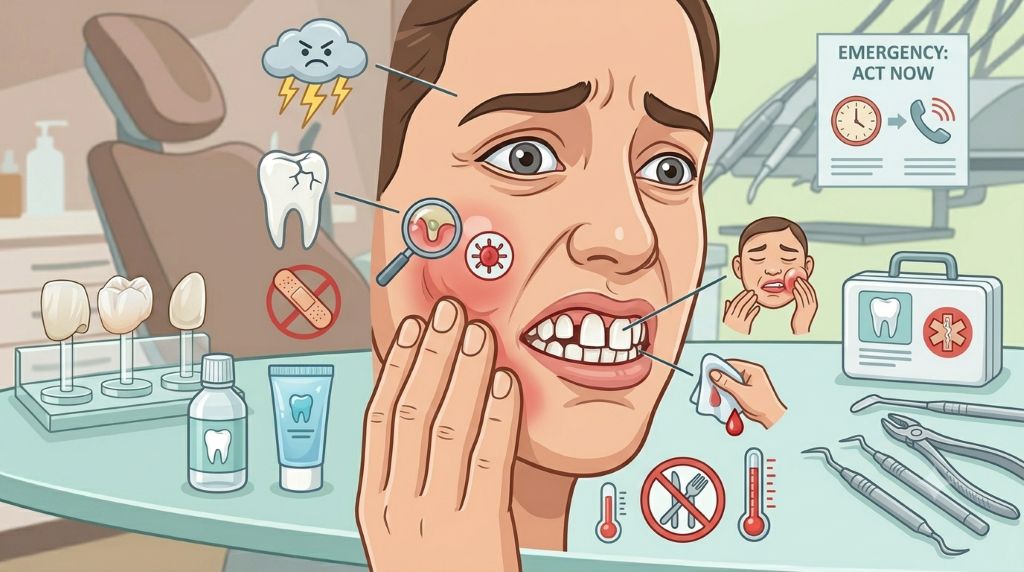
10 dental emergency signs and what to do
Here is a quick guide on what to do if you experience these common emergency signs:
- Trouble breathing or swallowing: Seek emergency medical care immediately; call 911.
- Severe or spreading mouth, face, or neck swelling: Go to the ER for severe swelling, especially if it involves your eye or breathing difficulty.
- Heavy mouth bleeding that will not stop: Seek emergency medical care immediately.
- Major face or jaw injury: Go to the ER, especially if there was any loss of consciousness, vomiting, or double vision after the injury.
- An adult tooth knocked completely out: Seek a dentist immediately and keep the tooth moist (follow the specific steps below).
- Severe tooth pain disrupting sleep or daily activities: Call a dentist for an urgent assessment.
- Toothache with fever or facial swelling: Seek urgent care. If you cannot reach a dentist and have a fever with facial swelling, go directly to the ER.
- A newly cracked or broken tooth: Contact a dentist promptly, even if the pain comes and goes.
- Severe pain or ongoing bleeding after an extraction: Contact the treating dentist urgently. Heavy, uncontrolled bleeding belongs in emergency medical care.
- A loose or broken crown, filling, bridge, or veneer: Call a dentist for advice on timing; report any pain, swelling, or injury.
(Note: This list helps you describe the problem; it cannot diagnose it. You do not need to have several signs before asking for help!)
If an adult tooth is knocked out, act immediately
Handle the tooth only by its crown (the part normally visible in the mouth), not its delicate root. If dirty, rinse it briefly and gently with milk or water. Do not scrub it, use chemicals, or dry it with a tissue.
If you are certain it is a permanent tooth and can safely put it back into its socket, do so gently without forcing it. If you cannot, place it in a glass of milk or an appropriate tooth-preservation solution and take it with you. Do not leave it dry on a counter or store it in plain tap water.
Get dental care immediately, ideally within 30 minutes. If more time has passed, still seek care urgently; do not automatically assume the tooth cannot be saved.
Do not put a knocked-out baby tooth back into its socket. That can severely harm the developing permanent tooth underneath. If you are unsure which type it is, keep it moist in a container and get immediate dental advice. Avoid keeping a loose tooth in a child’s mouth because it could be swallowed or inhaled.
Swelling or a bad taste can matter even when pain improves
A dental abscess is a severe infection that needs immediate treatment. Symptoms can include a bad toothache, swelling, fever, or a sudden unpleasant taste if the abscess drains. Pain may temporarily ease after drainage, but that does not mean the infection has resolved!
Call a dentist promptly rather than waiting for the swelling to disappear. If a fever and facial swelling occur and a dentist is unavailable, seek emergency medical care. Trouble breathing or swallowing requires immediate emergency attention.
Treatment depends on the cause and whether the tooth can be safely restored. Some infected teeth may be treated with root canal treatment; others need a different approach (like an extraction). An examination is needed to decide.
What can you do while arranging dental care?
For a toothache, gently rinse your mouth with warm water. If food is trapped between teeth, try gentle flossing rather than using a sharp tool. Never place an aspirin directly against a painful tooth or gum; it can chemically burn and injure the tissue.
After a cracked tooth or minor mouth injury, holding a cold compress against the outside of your face may help with swelling while you arrange care. These measures do not repair the injury; they just help manage symptoms.
For a suspected crack, avoid treating the sudden disappearance of pain as proof that the tooth is perfectly fine. Cracked-tooth symptoms can come and go, and the treatment depends entirely on the crack’s location and extent.
If you recently had dental treatment, follow the specific instructions from that office and contact them about new or worsening symptoms. Do not postpone emergency medical care to wait for their response.
What should you say when calling the dentist?
You do not need to know your exact medical diagnosis. A short description is enough to begin the conversation when you call:
“The problem started this morning. My lower right tooth hurts when I bite, and my cheek looks a little swollen. I have not injured it. How soon should I be assessed?”
When you call, be sure to include:
- When the problem started and whether it is getting worse.
- Any swelling, fever, bleeding, or recent injury to the face.
- Whether a whole tooth or a restoration (like a crown) has come out.
- Any recent dental treatment and relevant medical conditions or daily medications.
If an adult tooth was knocked out, say that first and give the exact time of the injury. Do not spend time trying to complete a routine online contact form before seeking immediate care!
Questions you may have
Here are a few common questions our Chandler patients ask when they are unsure if they are having a true dental emergency:
“My tooth stopped hurting. Can I cancel the appointment?”
Please call the office before deciding to cancel. In particular, an abscess may become far less painful after it drains, while still requiring urgent medical treatment. Explain what changed, including any swelling or unusual tastes in your mouth.
“Is every chipped tooth an ER problem?”
No. A dental assessment is usually the starting point for a chipped tooth without major facial injury or medical warning signs. Contact a dentist promptly to prevent further damage and determine the repair needed.
“What if I am not sure how urgent it is?”
Call us and describe the symptoms rather than trying to diagnose or label the problem yourself. For the emergency medical warning signs listed at the top of this page, always seek immediate medical care instead of waiting for a callback.
Watch: Causes of Tooth Pain
This patient education animation explains why tooth pain is a warning sign worth having checked, rather than something to wait out. Follow your dental team’s advice about whether your symptoms need urgent attention.
Contact our Chandler dental office
For a dental concern, call (480) 775-8600 and ask about an assessment. Availability must be confirmed by the office. If you cannot reach a dental provider and have medical warning signs, go to the ER or call 911 as appropriate.
For nonurgent appointment requests, use our contact page. You can also meet our dental team or read what to do if a dental implant feels loose.
Progressive Dentistry & Orthodontics
2995 W Elliot Rd Unit 1
Chandler, AZ 85224
Call (480) 775-8600.
This article provides general information, not a diagnosis or a substitute for urgent assessment. Do not delay care because your symptoms do not exactly match an example here.
Sources Consulted
- NHS. “How to Find an Emergency or Urgent NHS Dentist Appointment.”
- Mayo Clinic. “Tooth Abscess: Symptoms & Causes.”
- American Association of Endodontists. “Knocked Out Teeth.”
- American Association of Endodontists. “Cracked Teeth.”
- NHS. “Knocked-Out Tooth.”
- American Dental Association, MouthHealthy. “Dental Emergencies.”